


 Email this article
 Hide
Hide
 Show all

EDITORIAL
Journal of Technology and Science Education (JOTSE): 2025 in Review and Looking Ahead

Projectes d’Enginyeria, Universitat Politècnica de Catalunya (Spain)
The year 2025 has been a pivotal one for the Journal of Technology and Science Education (JOTSE), consolidating a sustained growth trajectory that has been evident in recent years and underscoring the journal’s continued internationalization and maturity within its scholarly community.
Throughout 2025, JOTSE has reinforced its editorial structure to support this growth. There have been several changes within the editorial board and reviewer team, with new appointments and some departures, all guided by the commitment to uphold a rigorous, efficient, and internationally recognized peer-review process. We warmly acknowledge and thank the editorial team members ( Jose Luis Aparicio Universidad de Valladolid, Spain, Dolors Grau, Universitat Politècnica de Catalunya, Spain, Emilio Rayon, Universitat Politècnica de València, Spain) who have contributed their expertise over recent years and who have now stepped back from active roles; their dedication has been invaluable.
During 2025, three issues were published. In March, the first regular issue of the year was released, featuring 14 articles. In September, the second regular issue included 25 articles, reflecting the notable increase in accepted contributions. Finally, in December, a special issue focused on Artificial Intelligence was published, comprising 12 articles and demonstrating the strong interest of the academic community in this theme as applied to education and technology. We extend special thanks to Alejandro Lorenzo-Lledó from the editorial team, whose efficient coordination was instrumental in the successful completion of this special issue.

Figure 1. JOTSE's evolution papers received (2010-2025)
One of the most remarkable developments of the year has been the significant rise in manuscript submissions. In 2025, a total of 632 manuscripts were received, representing an increase of nearly 30% compared with 2024 (490 manuscripts). This growth builds on an upward trend observed over recent years: between 2021 and 2025, submissions have increased by approximately 130%, confirming a clearly sustained growth pattern over time.
This increase in submissions is especially noteworthy in light of the article processing charge update implemented in January 2023, when the fee was raised from €295 to €395 per article. Despite this change, which initially stabilized daily submissions at an average of 1.30, the daily submission rate grew in 2025 to an average of 1.73, indicating that JOTSE’s visibility and standing continue to attract a growing number of authors even in a highly competitive publishing environment.
|
Year |
2020 |
2021 |
2022 |
2023 |
2024 |
2025 |
|
Published papers |
40 |
42 |
65 |
65 |
41 |
51 |
|
Received papers |
216 |
275 |
364 |
474 |
490 |
632 |
|
Accepted papers |
41 |
42 |
65 |
65 |
42 |
25 |
|
Rejected papers |
38 |
56 |
77 |
78 |
81 |
79 |
|
% accepted |
50,65% |
42,86% |
45,77% |
45,45% |
34,15% |
24,04% |
|
% rejected |
49,35% |
57,14% |
54,23% |
54,55% |
65,85% |
75,96% |
Table 1. Evolution of articles received, published and rejected by year
Consequently, the acceptance rate for 2025 declined to approximately 24%, with the rejection rate reaching around 76%. These figures reflect a selective editorial process increasingly oriented toward maintaining and enhancing the scientific quality of published research.
Regarding the geographical distribution of authors, JOTSE’s international reach continues to expand. In 2025, Spain accounted for around 30% of published articles, remaining the principal country of origin. Peru experienced substantial growth, contributing 18% of publications compared with 4% the previous year. Indonesia remained stable at approximately 11%, while the Philippines saw a significant increase, rising from 1.5% in 2024 to 16% in 2025. Additionally, Macedonia is newly represented among contributing countries this year, further enriching the journal’s global diversity.
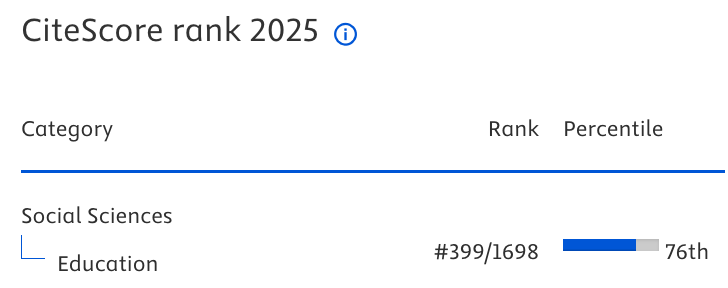
From the perspective of impact and indexing, JOTSE has maintained its position in Scopus, consolidating its placement in Q2 in the category of Education and in Q3 in Computer Science Applications. These standings reinforce the journal’s international visibility and its recognition within the fields of engineering education, technology, and applied sciences.
In summary, 2025 has been a year of growth, consolidation, and emerging challenges for JOTSE. Looking ahead, the primary challenge will be to balance continued growth with the maintenance of high editorial and scientific quality standards, ensuring that JOTSE remains an international reference in its field.
The editorial team sincerely thanks the authors, reviewers, and members of the editorial board for their unwavering commitment and dedication, without which these achievements would not be possible.
Declaration of Conflicting Interests
The author declared no potential conflicts of interest with respect to the research, authorship, and/or publication of this article.
Funding
The author received no financial support for the research, authorship, and/or publication of this article.
To cite this article:
|
Amante García, B. (2025). JOTSE’s editorial: Journal of Technology and Science Education (JOTSE): 2025 in Review and Looking Ahead. Journal of Technology and Science Education, 16(1), 1-2. https://doi.org/10.3926/jotse.4299 |

This work is licensed under a Creative Commons Attribution 4.0 International License
Journal of Technology and Science Education, 2011-2026
Online ISSN: 2013-6374; Print ISSN: 2014-5349; DL: B-2000-2012
Publisher: OmniaScience